Placement Preparation Guide banner
Introduction
Have you ever wondered why some students get placed in their very first campus drive while others sit for 10+ companies and still struggle?
For example:
- Why do some freshers crack product-based companies in 3 months of preparation?
- Why do toppers sometimes fail in interviews despite good marks?
- Why do some students get multiple offers while others get none?
- Why does the same syllabus produce very different placement results?
The answer is simple:
Structured Placement Preparation
Placement preparation is not about studying more — it is about studying the right things in the right order. Marks alone do not get you placed; a clear strategy does.
In this article, we will build a complete, practical roadmap for placement preparation — from Day 1 to your final HR round.
What Does Placement Preparation Actually Include?
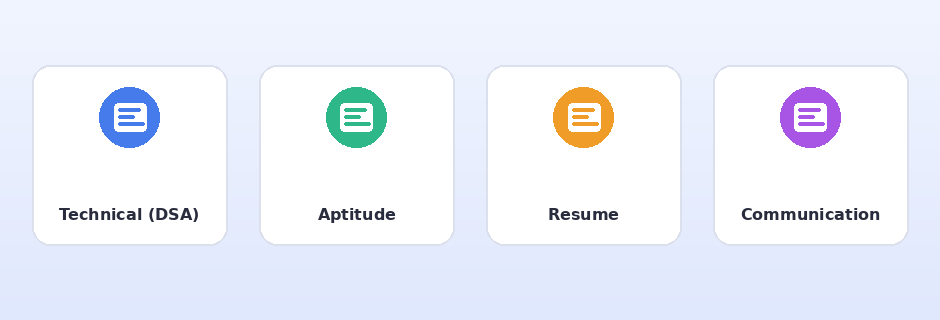
Four pillars of placement preparation
Most students think placement preparation means only coding practice. In reality, it has four equally important pillars:
1. Technical Skills (DSA, Core Subjects, Projects)
2. Aptitude & Reasoning
3. Resume & Profile Building
4. Communication & HR Readiness
Companies don’t just hire the smartest coder — they hire the most well-rounded candidate.
Ignoring even one of these pillars can cost you an offer, no matter how strong the other three are.
Ideal Placement Preparation Timeline
If you start early, here is a realistic 6-month roadmap.
Month 1-2 → Core Subjects + DSA Basics
Month 2-3 → DSA (Intermediate) + 1 Major Project
Month 3-4 → Aptitude + Mock Coding Tests
Month 4-5 → Resume Building + Mock Interviews
Month 5-6 → Company-Specific Prep + Revision
If placements are closer than 6 months, compress this timeline but never skip a pillar completely — reduce depth, not breadth.
Pillar 1: Technical Preparation
Data Structures and Algorithms (DSA)
This is the single most tested skill in technical interviews.
Arrays and Strings
Linked Lists
Stacks and Queues
Trees and Graphs
Recursion and Backtracking
Dynamic Programming
Sorting and Searching
Time and Space Complexity
Practice on platforms like:
LeetCode
HackerRank
GeeksforGeeks
Codeforces (for competitive edge)
Aim for 250–350 solved problems covering all major topics before final placements.
Core Computer Science Subjects
Interviewers frequently ask theory-based questions from:
Operating Systems (Process, Deadlock, Memory Management)
DBMS (Normalization, Joins, Transactions, Indexing)
Computer Networks (OSI Model, TCP/UDP, HTTP/HTTPS)
Object-Oriented Programming (Encapsulation, Inheritance, Polymorphism)
Example question:
Q: What is the difference between Process and Thread?
A: A process is an independent program in execution with its own
memory space, while a thread is a lightweight unit within a process
that shares memory with other threads of the same process.
Projects
Refer to a dedicated project-building strategy, but in short:
– Build 2-4 well-documented projects
– Host code on GitHub with a proper README
– Deploy at least one project live
– Be ready to explain every line you wrote
Interviewers spend a large portion of technical rounds discussing your projects — never list a project you cannot defend.
Pillar 2: Aptitude and Reasoning
Most companies use aptitude tests as the first filtering round.
Quantitative Aptitude
Percentages, Profit & Loss
Time, Speed and Distance
Time and Work
Permutations and Combinations
Probability
Logical Reasoning
Puzzles
Blood Relations
Series and Patterns
Syllogisms
Seating Arrangements
Verbal Ability
Reading Comprehension
Sentence Correction
Synonyms and Antonyms
Para Jumbles
Practice at least 2–3 full-length mock aptitude tests per week during the final preparation phase.
Pillar 3: Resume and Profile Building
Your resume is your first impression before you even speak to anyone.
Key resume priorities:
1. Keep it to one page
2. Highlight projects and technical skills clearly
3. Use measurable achievements, not generic statements
4. Make it ATS-friendly (simple format, standard headings)
Also strengthen your online presence:
LinkedIn Profile → Updated headline, skills, and projects
GitHub Profile → Clean repositories with proper READMEs
LeetCode/HackerRank Profile → Solved problem count visible
Recruiters often check your LinkedIn and GitHub even before the interview.
Pillar 4: Communication and HR Round Preparation
Technical skill gets you the interview call — communication often decides the final offer.
Common HR Interview Questions
1. Tell me about yourself
2. Why should we hire you?
3. What are your strengths and weaknesses?
4. Where do you see yourself in 5 years?
5. Why do you want to join our company?
How to Answer “Tell Me About Yourself”
Use this structure:
1. Brief academic background
2. Key technical skills
3. 1-2 major projects or achievements
4. Career goal aligned with the role
Example:
I am a final-year Computer Science student with strong skills in
Java and Spring Boot. I have built projects like an Employee
Management System using REST APIs and MySQL. I am passionate about
backend development and looking forward to contributing as a
Software Developer at your company.
Practice answers out loud, not just mentally — this builds real confidence.
Researching the Company Before the Interview
Before every interview, research:
Company’s core products or services
Recent news or achievements
Tech stack they use
Company culture and values
Role-specific responsibilities
Being able to say “I noticed your company recently launched X, and I’m excited about contributing to similar projects” creates a strong impression.
Mock Interviews and Group Discussions
Mock interviews build real confidence
Why Mock Interviews Matter
– Reduces interview anxiety
– Identifies weak areas before the real interview
– Improves body language and confidence
– Helps structure answers better
Practice with:
Seniors or placed friends
College Training & Placement Cell
Online mock interview platforms
Recording yourself and reviewing answers
Group Discussion Tips
– Speak clearly and confidently, not the loudest
– Listen actively and build on others’ points
– Support your points with examples or data
– Conclude the discussion if given the opportunity
Common Mistakes Students Make During Placement Prep
1. Focusing Only on DSA, Ignoring Core Subjects
Many companies test OS, DBMS, and CN as heavily as coding.
2. Not Practicing Mock Interviews
Knowing answers mentally is very different from speaking them confidently under pressure.
3. Applying Without Customizing the Resume
Sending the same generic resume to every company reduces shortlisting chances.
4. Ignoring Aptitude Rounds
Many strong coders get eliminated early simply because they skipped aptitude practice.
5. Panicking After Rejections
Avoid:
Giving up after 2-3 rejections
Use:
Reviewing feedback and improving weak areas before the next attempt
Placements are a numbers game combined with consistent improvement.
Final Placement Preparation Checklist
Before your placement season begins, confirm:
✔ 250+ DSA problems solved across all major topics
✔ Core subjects (OS, DBMS, CN, OOP) revised thoroughly
✔ 2-4 solid, well-documented projects ready to explain
✔ ATS-friendly, one-page resume prepared
✔ LinkedIn and GitHub profiles updated
✔ At least 3-5 mock interviews completed
✔ Common HR questions practiced out loud
✔ Basic company research process ready for any company
Conclusion
Placement preparation is not a last-minute sprint — it is a structured, multi-pillar journey covering technical skills, aptitude, resume building, and communication.
In this article, we learned:
- The four pillars of placement preparation
- A realistic month-by-month preparation timeline
- How to prepare DSA, core subjects, and projects
- How to strengthen aptitude and reasoning
- How to build an ATS-friendly resume and online profile
- How to prepare for HR rounds and group discussions
- Common mistakes to avoid during preparation
- A final checklist before placement season
Consistency beats intensity. A focused 2–3 hours of daily preparation over several months will always outperform random last-minute cramming.
Start today, track your progress weekly, and trust the process.
All the Best for Your Placements! 🚀